It’s harder than ever to know what to write about these days. I have a growing pile of half-written drafts on a range of topics sitting unpublished, waiting to be completed. The landscape of programming is changing so quickly that putting coherent thoughts into actual, hand-crafted writing often moves too slowly.
This problem is (for me at least) amplified by the contradiction of being a developer today. More than ever, many of us seem to have a love/hate relationship with our tools…and by tools, yes, I mean AI agents. I’ve come to realize that (again, speaking for myself) it has a lot to do with the two aspects of coding: creativity and problem-solving. These were the things that made me love coding.
AI agents have made one half of this better and the other half significantly worse.
Coding and Creativity
I have always loved to create. When I was younger, I used to paint and make electronic music. I largely stopped doing these things, not because I stopped wanting to create things, but because coding offered me a creative outlet (well, that and kids cut into my free time).
One of the first things I did when I started coding again around 1996 was to build an online grade book for my now-wife. This may not sound innovative today, but at the time these things didn’t exist. I put it up just for her, but within months it had thousands of users (which, again, doesn’t sound like much, but in 1996 it was pretty darn good).
I was hooked! From then on, even in my spare time, I’d build things just for fun and creativity. It’s even part of what drew me to being in Developer Relations. Traditional coding jobs offered opportunities to be creative from time to time, but most day-to-day work was fixing bugs or building features for President Business. Since much of DevRel involved building demos for talks or blog posts, it usually offered the ability to be as creative as I wanted to be on any given project, while the scope of projects (i.e., small, self-contained demos) meant that I was constantly creating new things.
AI and Creativity
I’m gonna say something some of you may disagree with, but for me, AI has increased my ability to be creative. I’m a good coder, but most often my creativity was hampered by skill (well, a combination of time and skill really, since, with more time, I might be able to build the skill). I had so many ideas for fun things to code, but I lacked the necessary prerequisite skills to effectively create them.
AI, for better or worse, eliminates that skill gap. When I have an idea for a demo or a side project, I am no longer thinking about whether I am capable of doing it; I can just do it. For instance, I had a wacky idea for a demo app for our conference booth at re:Invent that “gamifies” using the product. It was essentially a video game where you win by solving coding problems within the product. In years past, the complexity of building something like this would probably have been a sufficient blocker to getting it done. The result still took a lot of iterating with AI, but it got built and, I gotta admit, it’s better than I would ever have hand-crafted myself – even if not for reasons of skill but for reasons of time.
Or my ATProto events site, DevRel(ish). Could I have built that on my own? Absolutely. But it’s the kind of project that often sat either not started or unfinished because the need to develop skills (in this case, integrating with ATProto) would have taken so much of the time. Yes, I still ended up having to learn and do a lot of research around ATProto, mostly to guide the agent on how I wanted it built, but the actual coding was relatively quick and easy.
This ability to have an idea, no matter how crazy or outside your immediate set of skills, is powerful…but there’s a major trade-off.
Coding and Problem-solving
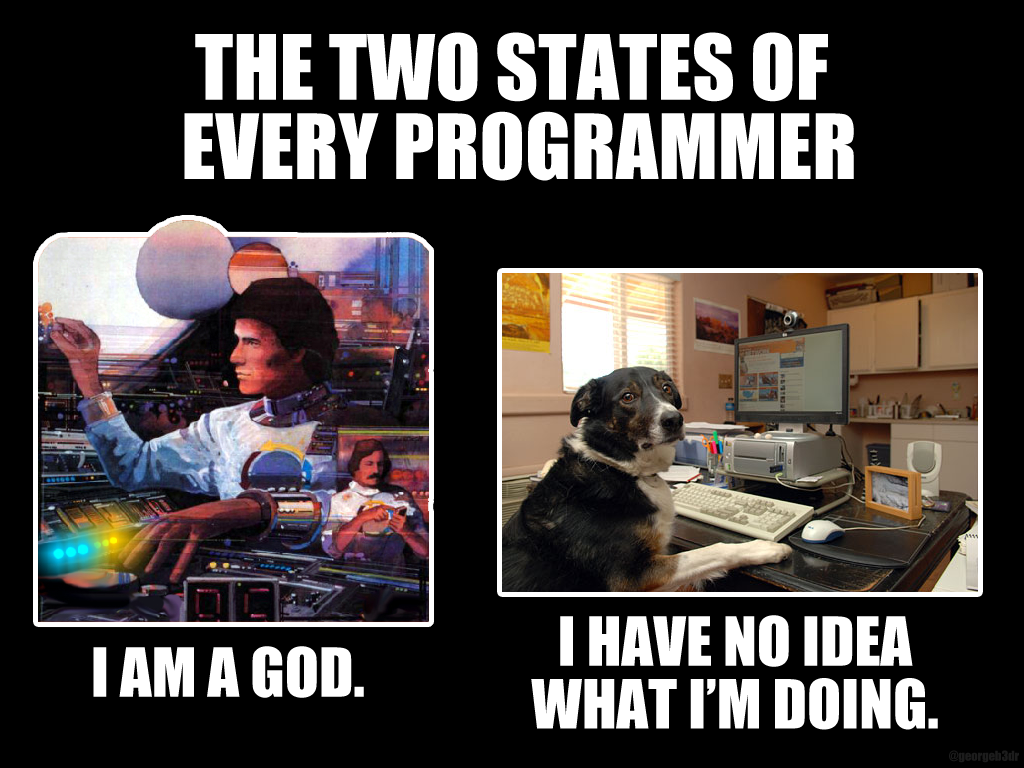
Every developer is familiar with memes like this one, as there are plentiful variations of them out there because it was such a universal feeling. That “I am a god” feeling came from the act of problem-solving.
Going back to my first ever coding project, the grade book, I remember the feeling when I’d figured out how to allow all the complexities around grades, including relative weights, so that it could work for any type of customized grading system a teacher might have. The site is long dead, but I still remember the excitement I had when I solved the problem I needed to build it properly.
Or when I (again, decades ago, so it sounds far less cool today) built a tool that calculated locations closest to your address. Or when I figured out how to implement the nested set model for category trees in ColdFusion. This may sound boring, but I was so excited about that one that I wrote my first ever publication in 2008 on the topic (in print, no less!). I could go on, but the point is that I can point to so many times that I had this feeling throughout my career because the feeling is exhilarating enough that it stays vividly in my memory.
The joy that this feeling of solving a difficult problem can bring is so fulfilling that it can make the most mundane-sounding coding tasks exciting. And, let’s be honest, most coding tasks end up being mundane-sounding, because most of us work for President Business after all.
AI and Problem-solving
Unfortunately, that joy is almost entirely gone from coding, as solving these types of problems is now offloaded to the agent. It’s no longer “I am a god,” but my agent is…and there’s no joy in that. I could still solve the problem myself, but why? The agent will literally solve, in seconds or minutes, what would take me hours or days.
It turns out that this feeling of exhilaration from solving a complex problem was far more meaningful than I realized. Yes, AI has been a boon for my creativity, allowing me to imagine building things that might have been unrealistic beforehand, but a lot of the joy in the creation process is now gone. Even problems that take a lot of iteration and even hands-on research alongside the agent to solve don’t bring that same momentary feeling of god-likeness. It’s effortful but ultimately empty.
Perhaps the current generation of coders who got their start in the past 5 years and for whom AI has always been a factor will be able to get the joy of creativity without this sense of loss. I hope so, because, at least for me, I feel the loss more deeply than the gain.
P.S. Yes, feeling loss more than gain is a known cognitive bias.